How to Teach Canicross Commands at Running Speed
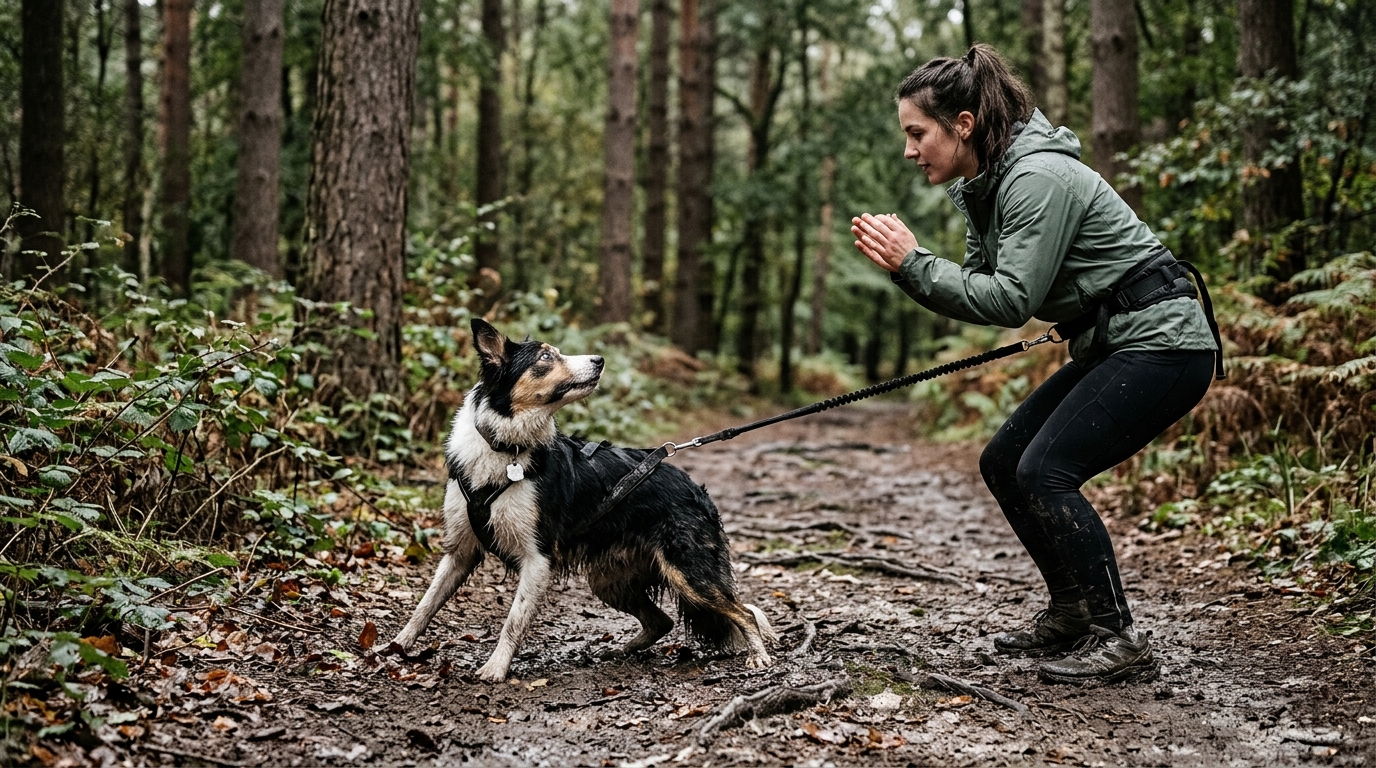
The calm, obedient walk you trained goes out the window the second you clip on a canicross belt and pick up the pace. That harness shift tells your dog it’s time to work, which can turn them into a freight train pulling toward the nearest distraction. Getting that controlled chaos comes down to mastering four commands at speed: “Steady”, “Left”, “Right”, and “On-By”.
How Do You Teach the “Steady” Command at Speed?
“Steady” is your speed-regulation cue—it tells your dog to slow down or pause while you’re still moving. The biggest mistake is training it at a walk and expecting it to hold up at a run. A scent-driven dog will happily sprint into trouble because they haven’t practised hitting the brakes with their adrenaline pumping.
You teach it by starting with a loose lead at a jog. Shout “Steady!” just before you come to an abrupt halt, and reward the dog the moment they stop.
How the drill works
Build this up gradually:
- Loose lead start – attach the belt, keep the lead slack, and jog a few metres.
- Abrupt stop – shout “Steady!” in a clear, upbeat tone, then halt.
- Reward – a quick treat or a pat the moment the dog stops, even if there’s a half-second lag.
- Lengthen the run – each session, add a few more metres before the stop.
Short sessions, a few minutes several times a week, teach a brake cue faster than one long session, and it holds even when a distraction appears ahead. The key is consistency. Short, frequent drills keep the dog’s focus high enough to override the pull instinct.
Directional Training: Left, Right, and “On‑By”
In UK canicross circles, “Left” and “Right” have largely replaced the traditional sled-dog terms “Haw” and “Gee”. This isn’t just cosmetic. Using plain English removes the language barrier when you’re weaving around other runners or dog walkers on a narrow woodland trail.
Teaching Left and Right at speed
Directional cues are best taught through repetition and reward:
- Treat-guided turns – run straight, then call “Left!” and make a sharp 90-degree turn. As soon as the dog follows, reward them. Repeat on the opposite side.
- Progressive distractions – start on a quiet park path, then move to a busier trail. A dog that can obey the turn while a jogger passes is ready for a proper run.
The “On‑By” command
“On-By” tells the dog to keep moving past a distraction without stopping, sniffing, or veering. It’s an absolute lifesaver when you encounter cyclists, other runners, or livestock.
- Set the stage – use a stationary cone or a friend holding a stick as the distraction.
- Cue – as you approach, shout “On-By!” and maintain a steady pace.
- Reward only if the dog passes cleanly – no sniffing, no veering toward the object.
Dog runners generally agree that you have to teach “On-By” while actually running. If you slow down to say it, the dog treats it as an invitation to stop and sniff. Practised first with a low-key object and then with a real cyclist, the drill usually sorts the pull-to-investigate habit out.
Why Does My Dog Ignore Commands in a Canicross Harness?
Your dog ignores you because the canicross harness shifts their centre of gravity forward. This makes them feel like a working animal and can temporarily override their standard obedience training. You have to retrain your core commands with the harness actually on, starting at a slow walk before adding speed.
Breed-specific dynamics
Different breeds have different failure modes. Spaniels, with their nose-driven curiosity, often get distracted by scent trails the moment the belt tightens. Collies are more pressure-sensitive. A harness that pinches can make them freeze rather than obey. A Collie will often simply stand still if the belt’s pull feels uncomfortable, whereas a Spaniel will just bolt.
The harness factor
When you switch from a regular lead to a proper running setup, the dog’s brain rewrites its obedience hierarchy. The result is the classic “they listen at home but not on the trail” frustration.
The common error is trying to run a full session before the dog has mastered the basics on a short jog. The solution is to hit reset. Go back to five-minute walks with the belt, reinforcing your core commands before throwing speed back into the mix.
Gear and Setup: How the Harness Affects Training
A well-fitted harness is the foundation for every command. A poorly fitting one causes rubbing, which distracts the dog and makes running feel like a bit of a faff, if not downright painful.
Harness fit checklist
Getting the fit right matters more than the brand you buy:
- Snug but not tight – you should be able to slip two fingers between the harness and the dog’s ribcage.
- Even pressure points – the strap should sit flat on the shoulders. Restrictive harnesses can alter a dog’s natural gait, so any pinching will cause the dog to shift focus and potentially risk injury.
- Adjustable belt length – a towline that’s too long makes the dog feel detached, reducing the effectiveness of your commands.
Real-world product insights
When looking at the gear, you’re typically looking at roughly £40 to £80 for a proper harness. The Non-stop Dogwear Freemotion (around £70–£90) is a strong pulling harness. The trade-off is that it has no handle, so you can’t grab the dog quickly in a tight spot.
For runners on a tighter budget, the Zero DC Short (roughly £45) is worth the investment. It offers a lightweight feel and is easy to fit, though it can rub around the armpits on deep-chested breeds if the size is off. The best value choice is the Zero DC Short – it delivers solid control without the premium price tag, provided you measure carefully.
The missing step many overlook
Before you even think about command drills, check the harness’s belt placement. A common oversight is wearing the belt too high. The pull then goes through your lower back, you instinctively brace and hold the dog back, and your cues get muddled. According to CaniCross Trailrunners safety guidelines, you should adjust the belt so it sits low on the hips to protect your lower back. Once the belt sits properly, you can run upright and relaxed, and your voice cues become much easier to give consistently.
Canicross Command Drills
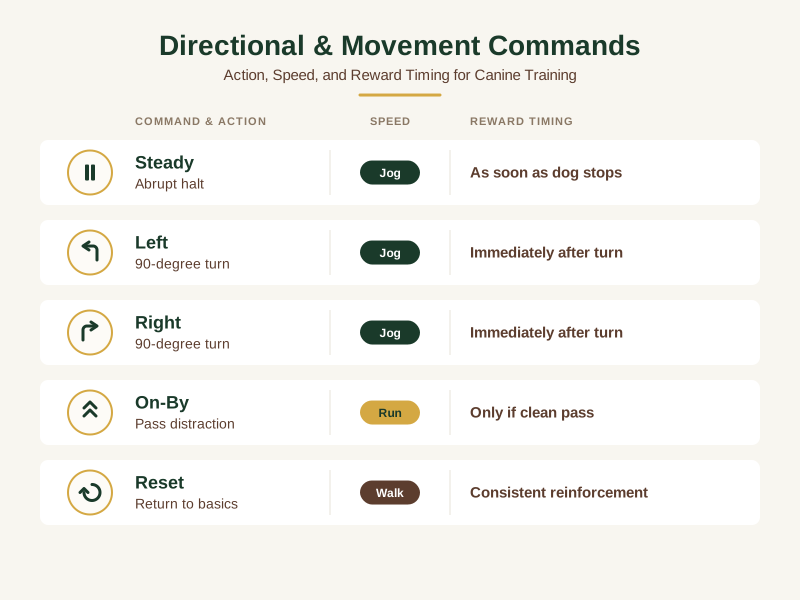
| Command | Speed | Primary Action | Reward Timing |
|---|---|---|---|
| Steady | Jog | Abrupt halt | As soon as dog stops |
| Left | Jog | 90-degree turn | Immediately after turn |
| Right | Jog | 90-degree turn | Immediately after turn |
| On-By | Run | Pass distraction | Only if clean pass |
| Reset | Walk | Return to basics | Consistent reinforcement |
Before You Buy
You now have a clear plan. Teach “Steady” at a jog, nail “Left” and “Right” with treat-guided turns, and lock in “On-By” for any distraction that threatens to pull you off-track. Fit a properly adjusted harness – the Zero DC Short is a solid, budget-friendly choice, while the Non-stop Dogwear Freemotion offers premium performance if you don’t mind the missing front handle. Keep sessions short, reward consistently, and remember that every breed has its own quirks.
Running with a well-trained dog feels like a partnership, not a tug-of-war. Stick to the drills, respect the gear, and soon you’ll be gliding down the trail with confidence, knowing both you and your four-legged mate are entirely in sync. Happy running!
Related Guides
For a complete overview, see our How to Start Running With Your Dog (The Right Way).
References
Note: General guidance only, verify details with a qualified professional or official source.