How to Start Running With Your Dog: A Safe First Month (UK)
As an Amazon Associate we earn from qualifying purchases. This page contains affiliate links — if you buy through them, we earn a small commission at no extra cost to you.
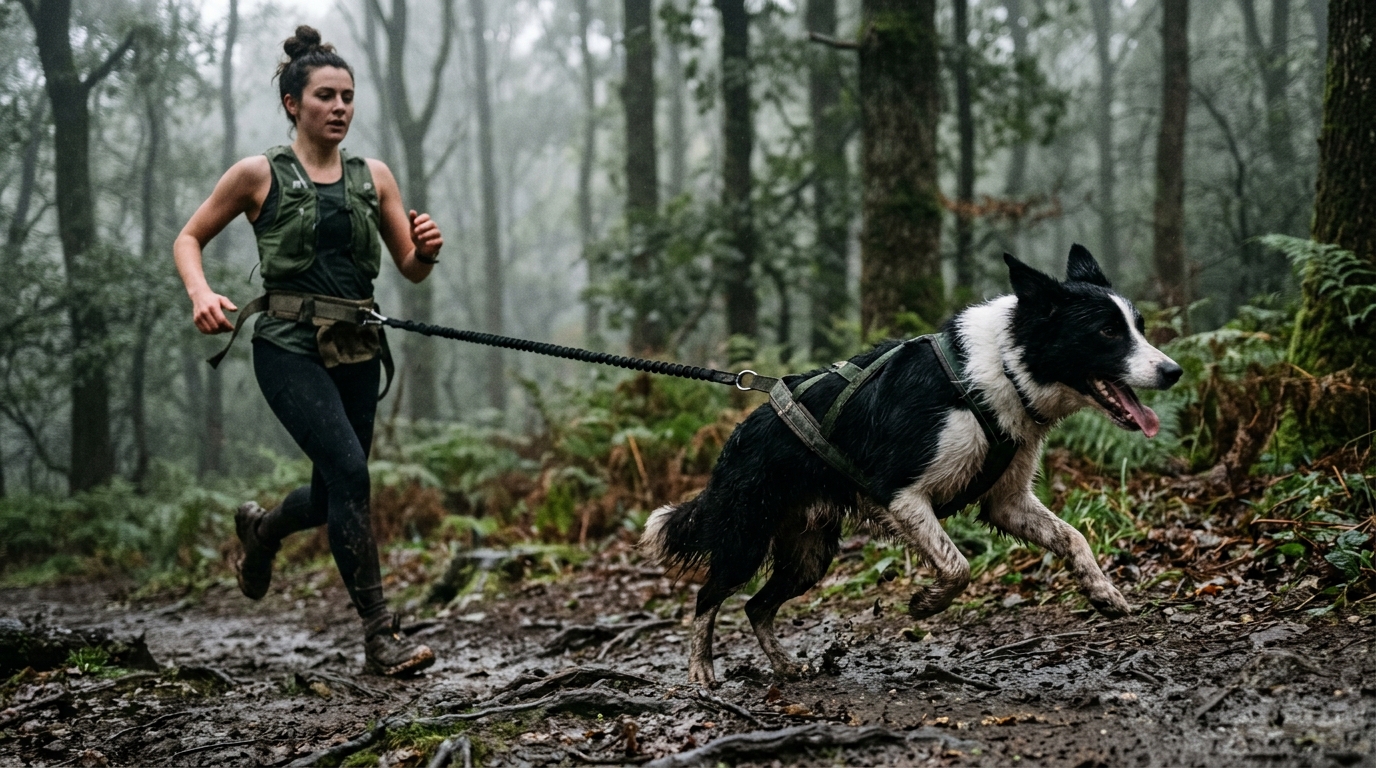
This guide is for people who already run, or want to, and would like the dog to come along. You don’t need to take up canicross, enter races or have the dog pulling you. Most dogs love a steady run with their person, provided four things are right: the dog is old and fit enough, it’s wearing a harness rather than a collar, you build up gradually, and you don’t run it on a hot day.
If you find your dog loves running out in front and leaning into the lead, that’s canicross. Our beginner’s roadmap to canicross picks up from there.
Want a printable version? Grab the free Starter Checklist: it covers the kit and the first sessions.
Is your dog ready to run?
Run through this list before the first jog. If any of it applies, sort that out first or stick to walking.
- Still growing? Running is repetitive impact on joints that are still developing. For most dogs that means waiting until at least 12 months, and longer for large and giant breeds, which can keep growing until about 18 months or beyond. Our puppy running guide explains growth plates and what you can do while you wait.
- Flat-faced breed? Pugs, French bulldogs, English bulldogs and similar breeds struggle to cool down through panting. A brisk walk is plenty for them.
- Health problems? Arthritis, heart or breathing problems, or a history of limping all need a vet’s go-ahead first.
- Carrying weight or out of condition? If your dog flags on a 30-minute brisk walk, build that up for a few weeks before you start jogging.
Breed matters less than you’d think for steady jogging. Collies, spaniels, pointers, vizslas and most terriers and crossbreeds usually take to it happily. Heavy, very deep-chested breeds generally prefer short, gentle runs to long ones.
Run in a harness, never a collar
A collar puts every tug on the dog’s throat. Even a well-behaved dog will lurch at a cat or a dropped sandwich, and at running pace that’s a real jolt to the neck. A harness spreads the force across the chest and shoulders.
What sort of harness depends on what the dog is doing:
- Running at your side on a loose lead: a well-fitted, Y-fronted everyday harness that leaves the shoulders free.
- Running ahead and pulling: a proper pulling harness of the kind used for canicross. Our guide to choosing one by your dog’s shape explains the options.
- “No-pull” harnesses with a chest clip help with control on walks, but they’re a poor choice for running. They work by turning the dog when it leans forward, which isn’t what you want at speed.
Running with the lead in your hand makes you run lopsided. A hands-free waist belt with a short bungee lead fixes that and absorbs the odd lunge. The Ruffwear Omnijore joring system (paid link) is one widely available belt-and-line set. Our belt guide explains how to wear one without hurting your back.
View Ruffwear Omnijore joring system on Amazon → (paid link)
The four-week plan
This assumes a healthy adult dog and runs three times a week, with rest days in between. The jog sections are easy running: you should be able to talk.
| Week | Each session | Focus |
|---|---|---|
| 1 | 10 min walk, then 4 × 1 min jog with 2 min walking between | A “let’s go” cue as you set off; the lead stays loose |
| 2 | 10 min walk, then 4 × 2 min jog with 2 min walking between | Steady pace; a quick sniff only when you allow it |
| 3 | 5 min walk, then 3 × 5 min jog with 2 min walking between | Turning, stopping and slowing on cue |
| 4 | 5 min walk, then 15–20 min continuous easy jog | Even rhythm; finish with 5 min walking |
Check the dog the morning after. If it’s stiff, limping or reluctant on the next walk, repeat the previous week. Stop straight away for any limping during a run.
Two problems turn up in almost everyone’s first month:
- The dog drags you along. See how to run with a dog that pulls for setup and the “with me” routine.
- The dog stops, sniffs or won’t keep going. See my dog won’t pull on runs. It’s often the harness, the surface or simply boredom.
Once the basics stick, a few voice cues (“steady”, “left”, “right”, “on by” for passing distractions) make every run calmer. Our command training guide shows how to teach them at running pace.
Weather, surfaces and the rules that catch runners out
Heat is the big one. Dogs cool mainly by panting, which is far less efficient than sweating. A temperature you find pleasant for a run can be too warm for a working dog, especially when it’s humid. In summer, run early in the morning or late in the evening, carry water, and skip the run on hot days. Our hot weather guide covers safe temperatures and the signs of heatstroke, and our hydration guide covers how much water to take.
Cold is rarely a problem for a healthy, moving dog in a UK winter. Wipe paws after gritted roads, because rock salt irritates pads. Thin-coated and small dogs may want a coat on the walk home.
Surfaces: grass, forest tracks and packed earth are kinder to joints than tarmac. Summer pavements can get hot enough to burn pads. If the back of your hand can’t stay on the ground for five seconds, it’s too hot for paws.
Where you can run: public footpaths and bridleways are fine with the dog under close control. On open access land (moorland, heath, downland) dogs must be on a lead of no more than two metres from 1 March to 31 July, to protect ground-nesting birds, and around livestock all year. Since March 2026 the fine for livestock worrying is unlimited, and the offence covers roads and paths too. Slow to a walk and shorten up when you see sheep or cattle. Our legal and etiquette guide has the detail, including Scotland.
Common Questions
How far can my dog run?
A fit adult dog that has built up gradually can often comfortably manage the same 5 km you can, but build up to it over weeks, not days. Distance matters less than recovery: if the dog is happy and moving well the next day, the distance was fine.
Can I run with my dog on pavements?
Yes, for short stretches, but softer ground is better for both of you. On hot days, check the pavement temperature first.
Should my dog eat before a run?
Leave a gap of an hour or two after a meal before running, especially with deep-chested breeds. Feed after the run, once the dog has cooled down and settled.
What if my dog keeps stopping to sniff?
It’s normal at first. Use a consistent “let’s go” cue to keep moving, and give a proper sniff break at the end as a reward. If it carries on past the first few weeks, check the harness fit and route.
Your running-with-your-dog reading list
- When can a puppy start running?
- How to run with a dog that pulls
- My dog won’t pull on runs
- Teaching commands at running speed
- Running with your dog in hot weather
- Ready for more? Start canicross
References
- GOV.UK: The Countryside Code
- Peak District National Park: dogs and access land
- Defra: law changes strengthen protection for livestock
- The Kennel Club
As an Amazon Associate we earn from qualifying purchases.
Note: General guidance only, verify details with a qualified professional or official source.