How to Run With a Dog That Pulls (Without Getting Dragged)
As an Amazon Associate we earn from qualifying purchases. This page contains affiliate links — if you buy through them, we earn a small commission at no extra cost to you.
Running with a dog that drags you feels like a tug-of-war you never signed up for. If your morning jog looks more like a cardio-punishment, the fix isn’t just running faster. Getting a pulling dog under control comes down to mechanical leverage—specifically, swapping to a front-clip harness—and retraining their default pace. Here’s how to stop being dragged across the pavement and get your stride back.
Front-Clip, Back-Clip, or Let Them Pull?
There are two honest answers to a dog that pulls on runs, and they need different kit.
Option 1: teach the dog to run beside you. If you want a dog that jogs at your side on a normal lead, a harness with a chest (front) clip is a useful training aid at walking pace and a slow jog. When the dog leans forward, the chest clip turns it back towards you, which takes the reward out of pulling. It isn’t something to run fast in, because it works by twisting the dog’s front end, so treat it as a stage while the “with me” cue below sinks in.
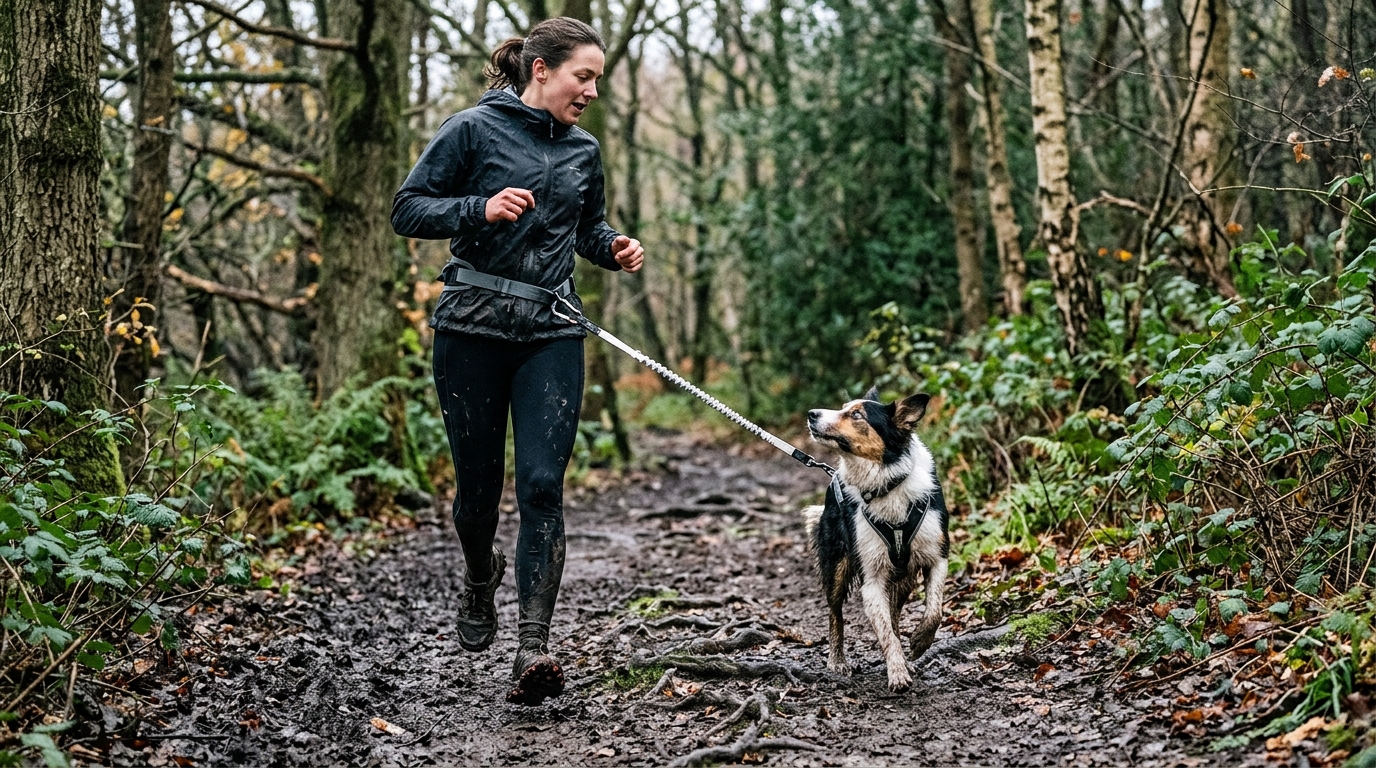
Option 2: let the dog pull, properly. Many dogs that drag you along are simply telling you they’d love canicross. Put them in a proper pulling harness (the line attaches on the dog’s back), clip the line to a padded belt on your hips, and use a bungee line to soften the jolts. Then the pull becomes help instead of a fight, and your job is to teach “steady”, not “stop pulling”. Our canicross roadmap explains how to start.
| Front-clip (no-pull) harness | Pulling harness + belt + bungee | |
|---|---|---|
| What it’s for | Teaching loose-lead walking and easy jogging at your side | Letting the dog pull you along in front |
| Where the line attaches | Ring on the dog’s chest | Loop on the dog’s back, to the front of your belt |
| Good for fast running? | No; it alters the dog’s movement | Yes; it’s what it’s designed for |
| Typical UK price | About £20–£60 | Harness about £40–£90, plus a belt and line |
What doesn’t work is the middle ground most people try first: an ordinary back-clip walking harness or collar, a lead in your hand, and a dog hauling at the end of it. You get the pull without the kit to handle it.
Step 1: Desensitisation to the Harness
You can’t just snap a harness on and hit the pavement. The first 10-15 minutes each day should be about getting the dog used to the feel of the gear, not speed.
- Wear it around the house. Let the dog stroll with the harness on for a few minutes while you’re lounging. Dogs often treat a new harness like a novelty toy – they’ll sniff, paw, and sometimes try to shake it off. Let them settle; the more familiar it becomes, the less likely they’ll associate it with “run time”.
- Introduce the leash indoors. Clip the leash to the front-clip and let the dog drag it across the carpet or hardwood. This drag-test teaches the dog that the leash is part of the harness, not a separate restraint. Skipping this step and going straight outside often results in a sudden, startled pull that can spook the dog.
- Practice stopping and waiting. Stand still, give a clear “Stop” cue, and reward the dog for staying put even though the leash is taut. Then say “Wait” before you move forward. Consistency here builds the foundation for the later commands you’ll need on the trail.
A simple 3-step checklist to keep on your fridge:
- Harness on at home for 5-10 min daily.
- Leash attached, let the dog drag it indoors.
- “Stop” → reward; “Wait” → reward; repeat.
Some dogs are wary of any new harness at first, so don’t skip these desensitisation steps.
Step 2: The “With Me” Command
Now the dog knows the harness and leash, it’s time to teach it to run alongside you, not ahead of you.
- Choose a cue – “With me”, “Let’s go”, or any short word you like. Consistency matters more than the exact phrase.
- Keep the leash short but loose. A line of 2–3 metres gives you control without giving the dog a runway to sprint ahead. The classic mistake is using a long, slack line; the dog gets too much freedom and you end up being pulled.
- Reward side-by-side running. As soon as the dog matches your pace, give a treat or a burst of praise. The moment the dog pulls ahead, stop and turn the opposite direction. This turn-away technique breaks momentum and forces the dog to chase you back, reinforcing the “run with me” cue.
A chest clip on its own won’t stop a determined puller. The “With me” cue does the heavy lifting.
Do’s and Don’ts
- Do use a short, relaxed line.
- Don’t let the leash become a taut rope – a tight line means you’re already losing.
- Do reward immediately when the dog stays beside you.
- Don’t rely on a retractable leash; it’s a safety hazard on trails.
Step 3: Troubleshooting Common Issues
Even with the right gear and cue, things can go sideways. Here’s a quick flow-chart you can run through on the run.
- Dog stops mid-run. Don’t yank the leash. Call the dog back with “Come” and reward a short burst of movement. If the pause repeats, you’re probably running too fast for the dog’s current fitness – drop the pace and build endurance.
- Dog refuses to pull. Often a sign of over-excitement or low fitness. Shorten the distance, jog at a walk-jog rhythm, and gradually extend the run.
- Bungee leash gives too much slack. A bungee line absorbs shock but doesn’t stop pulling. It merely makes the tug less painful for you. If the dog still drags you, tighten the leash length or switch to a non-bungee front-clip line for training sessions.
If you’re using a bungee line, treat it as a training aid, not a solution to pulling. The core work still lies in the harness and cue.
UK-Specific Considerations
Running in the UK isn’t just about the dog – it’s about the law, the weather, and the terrain.
- Leash laws. Under the UK Government’s Highway Code, dogs must be kept on a short lead on pavements or paths shared with cyclists. Many local councils also require dogs to be on leads in public parks, especially near livestock. In Richmond Park and Bushy Park, for example, dogs must be on a lead during the deer birthing season (May to July). Always check the local council’s website before you set off.
- Weather. British rain can turn a gravel path into a slick mudslide in minutes. Waterproof, quick-dry harnesses keep the chest area dry, and a bungee leash with rust-proof hardware prevents corrosion.
- Terrain. Trails such as Epping Forest or the South Downs are riddled with roots and soft ground. Slow down on rooty, slippery sections and keep the line short enough that the dog can’t cut across your feet.
Mud and Paws Picks: Product Recommendations
Which kit makes sense depends on which option you chose above.
If you’re teaching your dog to run at your side: any well-fitted harness with both a chest ring and a back ring, such as TrueLove’s Front Line no-pull harness, will do for the training stage. Use the chest ring while you’re teaching, and the back ring once the dog jogs politely. Budget harnesses vary in stitching quality, so check the seams and buckles regularly if your dog is a strong puller.
If you’re letting your dog pull (canicross-style):
- A pulling harness that suits your dog’s shape. The Non-stop Dogwear Freemotion is a popular all-rounder for medium and large dogs; the Zero DC Faster suits many deep-chested dogs; the Neewa Sled Pro is an X-back built for husky-type shapes. Shape matters more than brand, and our harness guide explains how to choose.
- A belt that sits on your hips. The Neewa Canicross Belt (paid link) is an affordable starting point. See our belt guide for how to wear one.
- A bungee line of about two metres. Our bungee line guide covers length and stretch.
Buy Neewa Canicross Belt on Amazon → (paid link)
Frequently Asked Questions
Is a front-clip harness bad for my dog’s neck?
Any well-fitted harness is far kinder than a collar for a dog that pulls, because the force goes across the chest rather than the windpipe. A front-clip harness is fine for walking and gentle jogging while you train, but it alters the dog’s movement, so don’t use it for fast running. If your dog loves to pull, a canicross pulling harness is the better answer.
Can I use a retractable leash for running?
No. Retractable leashes offer almost zero control at speed and can cause severe friction burns or tangles if your dog suddenly bolts. The PDSA strongly advises using a fixed-length lead for safety, especially in busy parks or on mixed-use trails where runners and cyclists cross paths.
How do I stop my dog from barking at other runners?
Barking is usually a sign of over-arousal or frustration. Start your training in a quiet, low-distraction area and reward your dog for looking at you instead of passing joggers. Using a consistent “With me” cue helps break their fixation and keeps their attention squarely on the run.
Ready to Start?
You’ve got the gear basics, a clear training plan, and the UK-specific know-how to keep both you and your dog safe on the trail. The hardest part is often just getting started – a short, controlled jog in your local park will let you test the harness, the “With me” cue, and the bungee line without the pressure of a long run.
With that in mind, why not take the next step and grab our free Canicross Starter Checklist? It’s a quick download that pulls together the kit and the early-session basics, so you can keep running strong together.
If you’re ready to gear up, our canicross harness guide explains how to match a harness to your dog’s shape. If the opposite is your problem, read my dog won’t pull on runs.
Running with a pulling dog doesn’t have to be a battle. With the right setup for the way your dog wants to run, a solid “With me” command and a bit of patience, you’ll soon be enjoying the joy of sharing the trail, not the drag. Happy trails!
Related Guides
For a complete overview, see our guide to starting to run with your dog, or if your dog is a born puller, the canicross beginner’s roadmap.
Where I Learned This
As an Amazon Associate we earn from qualifying purchases.
Note: General guidance only, verify details with a qualified professional or official source.