Canicross Bungee Lines: How Long Should You Run?
As an Amazon Associate we earn from qualifying purchases. This page contains affiliate links — if you buy through them, we earn a small commission at no extra cost to you.
Most canicross bungee lines are sold with a length that confuses new runners. The tag says 2 metres, but the line that arrives barely reaches your waist. That’s because manufacturers almost always list the fully stretched length, not the resting length you see out of the box. Get this wrong, and you’ll have a line that either trips you up on a muddy trail or yanks you off balance the second your dog pulls. Here’s how to cut through the marketing and get the right length for UK terrain.
Why Is the “Unstretched” vs. “Stretched” Line Length So Confusing?
When a product says “2m line”, it almost always means 2 metres when fully stretched by a pulling dog, not the resting length you see out of the box. The actual unstretched length is typically around 1.4m — roughly 60–75% of the fully stretched length.
Why does this matter? If you buy a line assuming it will give you two metres of slack from hip to harness, you’ll be caught out as soon as your dog pulls. That sudden reduction can pull a runner off balance, especially on uneven UK trails where a stray tree root can send the line jerking sideways.
Allow for the stretch when you measure, or a line that looks right can turn out too short.
Static vs. Bungee: The Physics of the Run
A static lead is essentially a dead-weight rope with zero shock absorption. Every time your dog lunges, the force travels straight into your hips, which makes for a jarring run and risks straining both of you.
A bungee line, by contrast, works like a spring. When the dog pulls, the elastic core stretches, absorbing the initial shock and then returning that energy to the dog as a gentle tug forward. This reduces the impact on your spine and helps the dog maintain a smoother rhythm.
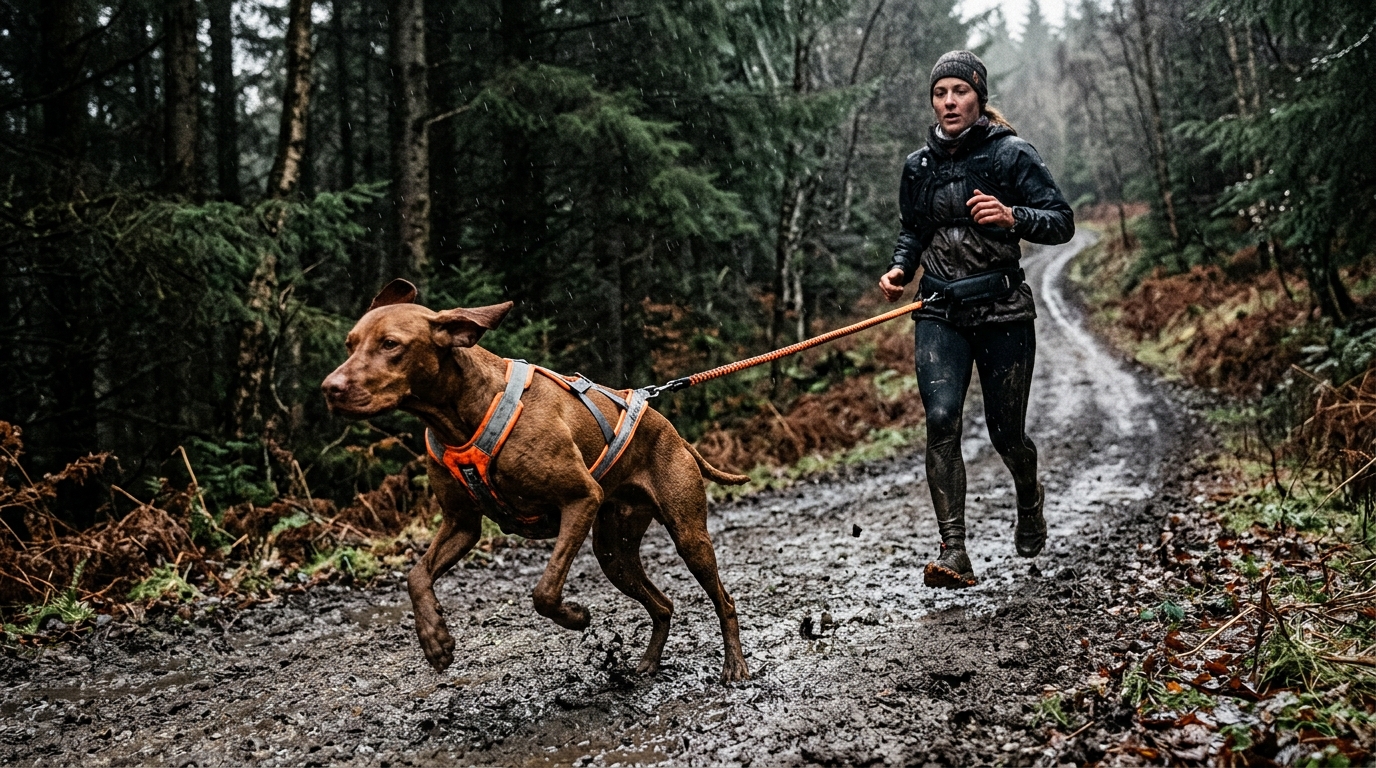
The pulling angle is where length really makes a difference. A shorter line forces the dog’s pull to be more directly behind you, tightening the angle and giving you tighter steering control. A longer line lets the dog run further ahead, widening the angle and giving the dog more forward momentum. This is fine for flat road runs – though Rule 56 of the Highway Code requires dogs on roads to be kept on a short lead – but it becomes risky on twisty, muddy paths where the line can swing around your legs.
A diagram that’s often used in belt guides shows a runner standing still with a 1.5m line (tight angle) versus a runner sprinting with a 2.2m line (looser angle). The longer set-up visibly widens the pull vector, which is why many UK trail runners shorten their line when the ground gets slick.
The Ruffwear Roamer bungee lead (paid link) is an adjustable stretch lead (about 1.7–2.1 m) you can hold or wear at the waist. It’s made for walks and hikes; for a strong puller in a canicross harness, a dedicated canicross line suits better.
Buy Ruffwear Roamer bungee lead on Amazon → (paid link)
Now that you understand the mechanics, you can decide what stretch and length actually suit your run.
The “3-Second Rule”: Choosing Your Length
If you’re wondering exactly how long your canicross bungee line should be, the most reliable approach is to aim for a stretched length of 1.8m to 2.0m for most UK runs. This length provides roughly three seconds of reaction time if your dog stops suddenly, which is the sweet spot for balancing safety and control. A 2.0m stretched line will typically sit at around 1.4m unstretched, keeping it taut enough to avoid dragging in the mud but long enough to absorb the shock of a sudden lunge. For tight, technical woodland trails with heavy root coverage, dropping down to a 1.2m to 1.5m stretched line prevents the bungee from wrapping around your legs. Conversely, open moorland runs might allow for a 2.5m line, but for the vast majority of mixed trail and park routes, a 2.0m stretched line is exactly what you need to maintain a smooth, safe rhythm.
The core actionable advice breaks down into three practical length buckets for UK conditions.
Short Lines (1.2m – 1.5m)
Best for: muddy trails, tight forest switches, and narrow footpaths where the line can easily wrap around roots or your own legs.
Why it works: With only about three seconds of slack, the dog can’t get far enough ahead to swing under your feet. The tighter angle also keeps the line clear of the mud.
Medium Lines (1.8m – 2.0m)
Best for: mixed terrain, road running, and most park-run style routes.
Why it works: This length provides roughly three seconds of reaction time on level ground while still keeping the pulling angle narrow enough for good handling. It’s the sweet spot most UK runners gravitate towards.
Long Lines (2.5m +)
Best for: deep mud, long straight country lanes, or sprint intervals where you deliberately let the dog pull ahead.
Why it works: Extra slack lets the dog build momentum before the line engages, useful for steep climbs. The trade-off is a higher risk of the line looping around your legs or snagging on undergrowth.
Decision matrix
| Terrain | Recommended Length | Reason |
|---|---|---|
| Muddy forest path | 1.2m – 1.5m | Prevents tangling, tighter pull angle |
| Mixed trail / road | 1.8m – 2.0m | Balanced reaction time, responsive |
| Open moorland / sprint | 2.5m + | Allows dog to build speed, accept more slack |
Shortening the line on muddy trails stops it wrapping around your legs, and that holds across the UK’s wet, root-laden countryside.
What to Avoid: The Safety Failures
Here are the common shortcuts that consistently fail under pressure:
- Car bungee cords: Designed for suspending luggage, not for the dynamic forces of a dog sprint. The plastic coating can melt under friction, and the snap-back is violent enough to cause injury.
- Thin webbing: A common indicator of cheap construction; it stretches too much and wears out quickly, offering little shock absorption.
- Missing or low-quality hardware: An auto-locking carabiner and a heavy-duty swivel are non-negotiable. A swivel that seizes can turn a gentle pull into a dangerous twist, especially on uneven ground.
These cheap shortcuts are where most line problems start. If you spot any of these red flags on a product page, walk away.
Recommended Lines (UK Context)
Non-stop Dogwear Touring Bungee
A solid line with a rubber core and a twist-lock carabiner. Its heavier build suits strong pullers more than small dogs. Expect a price tag approximately £22–£25 (standard) or £49–£55 (adjustable version), which matches the durability you’ll need for regular hill work in the Lake District.
Neewa Bungee Line
Lightweight and equipped with its own carabiner, this line delivers smooth shock absorption for bike-joring and canicross alike. Check all the hardware is there when it arrives. Approximately £22–£30.
Budget Alternative: TrueLove Bungee Dog Leash
If you’re not ready to drop bigger sums, the TrueLove leash offers decent shock absorption for moderate pullers at roughly £12–£18. It does tend to loosen over time and isn’t the best in rain-soaked mud, but it’s a solid starter line for weekend jogs around town.
When weighing these options, remember the trade-off: the premium Non-stop line gives you belt and braces durability for heavy-pulling breeds, while the TrueLove line is the cheaper starting point for casual runners.
For a full rundown of the best gear, read through our blog archives.
How to Test Your New Bungee Line Safely
Before you head out onto a busy trail, you need to know exactly how your new line behaves under tension.
1. Measure the resting length
Lay the line flat on the floor without any tension. This tells you how far the line will drop when your dog slows down or stops to sniff, which helps you anticipate tripping hazards.
2. Test the maximum stretch
Have someone hold one end while you pull the other until the elastic core bottoms out. This lets you feel the exact moment the shock absorption ends and the static pull begins, so it doesn’t catch you off guard on a run.
3. Check the hip-to-harness distance
Clip the line to your running belt and your dog’s harness in a controlled environment like a garden. Walk behind them to see where the line naturally sits when they are trotting normally.
4. Assess the hardware under load
Give the line a few sharp tugs to ensure the swivel rotates freely and the carabiner stays locked. A seized swivel on a muddy run is a fast track to a twisted line and a tangled dog.
Quick Answers
Can I use a regular dog-walking bungee for canicross?
No. Standard walking bungees are usually too short and lack the swivel mechanism needed to prevent tangling at high speeds. They also rarely feature the heavy-duty elastic core required to absorb the sudden force of a sprinting dog.
Does a longer line make the dog pull harder?
Not directly. A longer line lets the dog get further ahead, which builds more momentum before the bungee engages, but it doesn’t change their actual pulling power. The main difference you will feel is less steering control when the line is slack.
How do I stop the line from tangling in mud?
Use a shorter line (around 1.5m stretched) on muddy trails and keep the bungee off the ground as much as possible. If you regularly run in wet conditions, look for lines with a stiffer outer webbing that resists soaking up water and sagging.
Do I need a line with a built-in handle?
Yes, having a traffic handle near the dog’s clip is incredibly useful. It allows you to grab the line securely and keep your dog close when passing other walkers, navigating road crossings, or adhering to Forestry England guidelines in busy woodlands.
Canicross Line Length Guide
| Terrain Type | Recommended Stretched Length | Key Benefit |
|---|---|---|
| Muddy Forest Path | 1.2m – 1.5m | Prevents tangling and keeps line clear of mud |
| Mixed Trail / Road | 1.8m – 2.0m | Provides three seconds of reaction time |
| Open Moorland / Sprint | 2.5m + | Allows dog to build momentum on steep climbs |
| Technical Woodland | 1.2m – 1.5m | Tighter angle reduces risk of wrapping around legs |
What to Do Next
You now have the maths behind line stretch, the physics that dictate how a bungee behaves, and a clear “3-Second Rule” to match length to terrain. Pick a line that gives you three seconds of reaction time, avoid cheap car-bungee hacks, and choose a reputable brand that backs up its hardware.
If you have specific questions about setting up your gear, feel free to reach out via our contact page, or read more about the Mud and Paws Team.
If you’re ready to fine-tune the rest of your setup – from harness choice to belt and line – get the free Canicross Starter Checklist. It’s a quick download that pulls the whole kit list into one place, so you’re not guessing what to buy next.
Happy trails, and may your runs be smooth, safe, and just the right amount of stretchy.
Related Guides
For a complete overview, see our Canicross Belt Guide: Waist vs Hip and Back Support.
Further Reading
As an Amazon Associate we earn from qualifying purchases.
Note: General guidance only, verify details with a qualified professional or official source.