How to Wear a Canicross Belt for Zero Back Pain
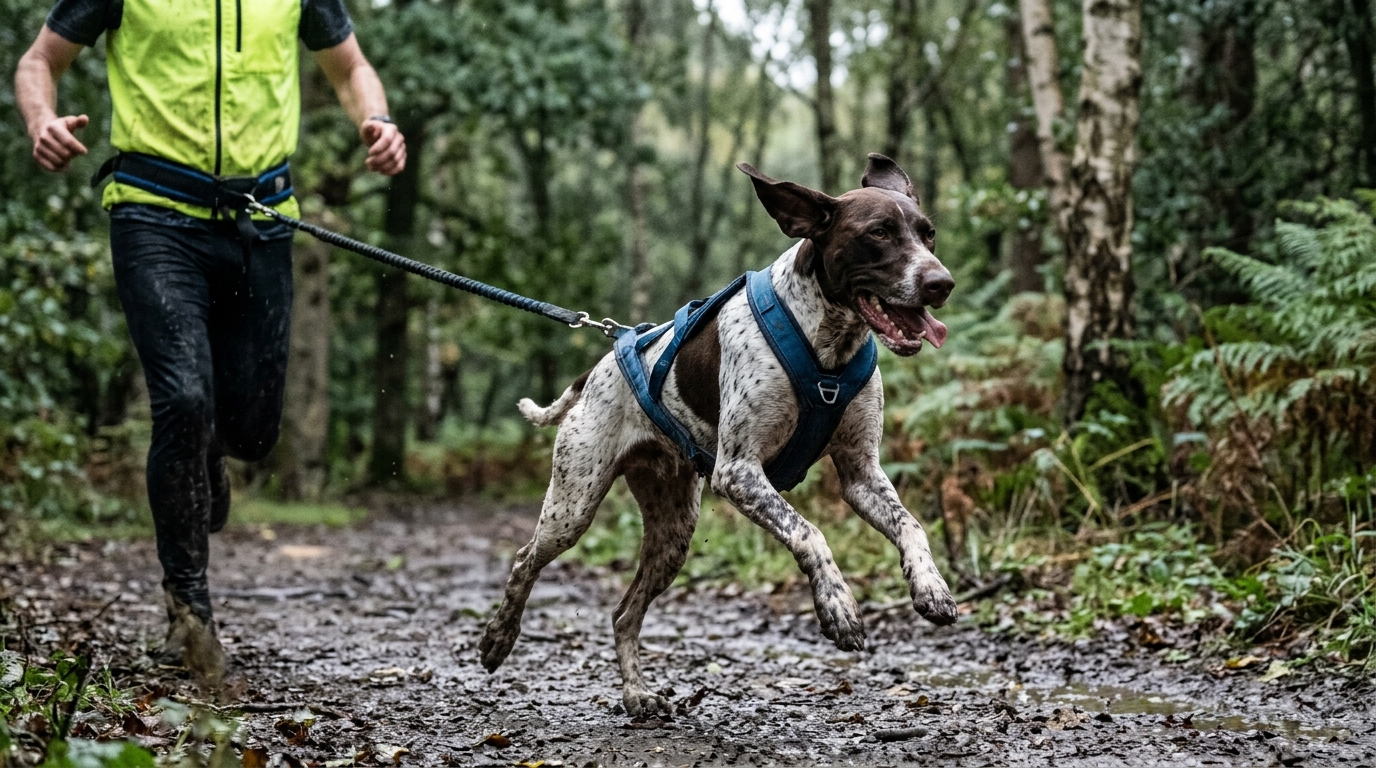
If you come back from canicross with an aching lower back or sore ribs, the belt is almost certainly sitting too high. A canicross belt belongs on your hips, not round your waist. Your pelvis can take a dog’s pull; the soft middle of your back can’t.
This guide covers your end of the line: where the belt sits, where the line attaches, which features are worth paying for, and how the belt, bungee line and clothing fit together. The dog’s end, the harness, has its own guide.
Why belt position matters
The dog pulls forwards and slightly downwards from in front of you. If the belt sits on your waist, that pull drags your middle forward while your legs carry on underneath you, so your lower back takes every tug. Run like that for a few kilometres and you’ll feel it the next day.
Lower the belt so its top edge rests on the bony ridge of your hips (the iliac crest) and the pull goes through your pelvis, close to your centre of gravity. You stay upright, the dog’s pull helps you along instead of folding you over, and you’re far more stable when the dog changes direction on a muddy corner.
The most common beginner mistake is wearing the belt at waist height because it feels more secure. It isn’t. Within a couple of kilometres it will either dig into your ribs or ride up and twist.
Fitting your belt in five steps
- Start loose. Undo every strap so you’re not working around someone else’s settings.
- Drop it onto your hips. The top edge should sit on, or just below, your hip bones. The wide, padded part goes at the back, over your lower back and the top of your bottom.
- Snug, not tight. Tighten until you can slide two fingers under the waistband. Any looser and it will move; any tighter and it rubs.
- Check the attachment is at the front. The dog runs ahead of you, so the line clips to a loop or ring at the front of the belt, low down, roughly in line with the middle of your body. Many belts have a sliding rail or a ring on a strap, so the line can move from side to side as the dog does.
- Do the test. Squat, jog on the spot and lean forward. If the belt creeps upwards, tighten slightly and fit the leg loops.
Problems after that, such as a belt that keeps riding up, slips down or twists, are covered step by step in our belt riding-up fixes.
Features worth paying for
Leg loops. The single most useful feature. Two straps round your upper thighs stop the belt climbing when the dog pulls. If your belt doesn’t have them, it will have to be tighter to stay put.
A wide, padded back. The pull is spread across the back of the belt, so a wider, padded section there is more comfortable over distance than a narrow running belt. Ordinary running or bum-bag belts sit too high and aren’t built for the load.
A quick-release on the line attachment. If the dog bolts after a deer or the line wraps round a tree, you want to be able to unclip fast. Check you can work it with cold, muddy hands.
Proper adjustment. People’s hip-to-waist shapes vary a lot, so look for adjustment on both sides and on the leg loops, not a single buckle at the front.
Pockets. Nice to have for keys, poo bags and treats. Don’t pay a lot extra for them.
As a rough guide, a well-made belt with leg loops and a padded back costs from about £35 to £90 in the UK, more from specialist brands. Fit matters more than the brand. If you can, try a couple of belts at a club taster session before you buy.
The belt is one part of a system
Your belt, the line and the dog’s harness work as a set, and most problems come from one part not matching the others.
- The line. A bungee line runs from the front of your belt to the back of the dog’s harness, usually about two metres when stretched. The elastic section takes the jolt out of sudden pulls, which your back will thank you for. Our bungee line guide explains length and stretch for different dogs and speeds.
- Buying as a set. Starter sets solve the matching problem, but only if the harness in the set suits your dog’s shape. Read whether canicross starter sets are worth buying before you decide.
- What you wear under it. Thick or slippery layers let the belt move, so tighten it after you’ve got your jacket on. Our what to wear for canicross covers shoes, layers and visibility for UK weather.
Quick Answers
Where should the line attach on a canicross belt?
At the front, low down and roughly central. The dog runs in front of you, so a front attachment keeps the pull straight. A sliding attachment lets the line move when the dog drifts to one side without twisting the belt.
Can I use an ordinary running belt for canicross?
No. Running belts sit on the waist and aren’t built to take a dog’s pull. You’ll get exactly the back pain and rib-digging a canicross belt is designed to avoid.
How tight should the belt be?
Snug enough not to move when you squat or lean forward, loose enough to slide two fingers under the waistband. Re-check it once you’re warmed up, because layers compress and straps settle.
Are leg loops really worth having?
Yes. They’re the most reliable way to stop the belt climbing towards your waist, which is the main cause of back pain in canicross.
My back still hurts with the belt on my hips. What next?
Check the line has an elastic section and isn’t too short, and that the dog isn’t hitting the end of the line at full speed every few strides. Work on the “steady” command too: our command guide shows how. If the pain carries on, see a physiotherapist.
Your end-of-the-line reading list
- Canicross belt riding up? 5 fixes
- Choosing a canicross bungee line
- Are canicross starter sets worth buying?
- What to wear for canicross in the UK
- Back to the start: the canicross roadmap
References
Note: General guidance only, verify details with a qualified professional or official source.