Bikejoring vs Canicross vs Scootering: Which Dog Sport Suits You?
As an Amazon Associate we earn from qualifying purchases. This page contains affiliate links — if you buy through them, we earn a small commission at no extra cost to you.
If your dog spends half of every walk staring down the trail, a standard lead probably isn’t channelling that energy. The question isn’t whether your dog wants to pull, but what you should be standing on when they do. The answer depends on your dog’s size, your own confidence on wheels, and the paths you have nearby. Here’s the practical difference between canicross, bikejoring, and scootering, and what it actually costs to get started in the UK.
What is the Difference Between Canicross, Bikejoring and Scootering?
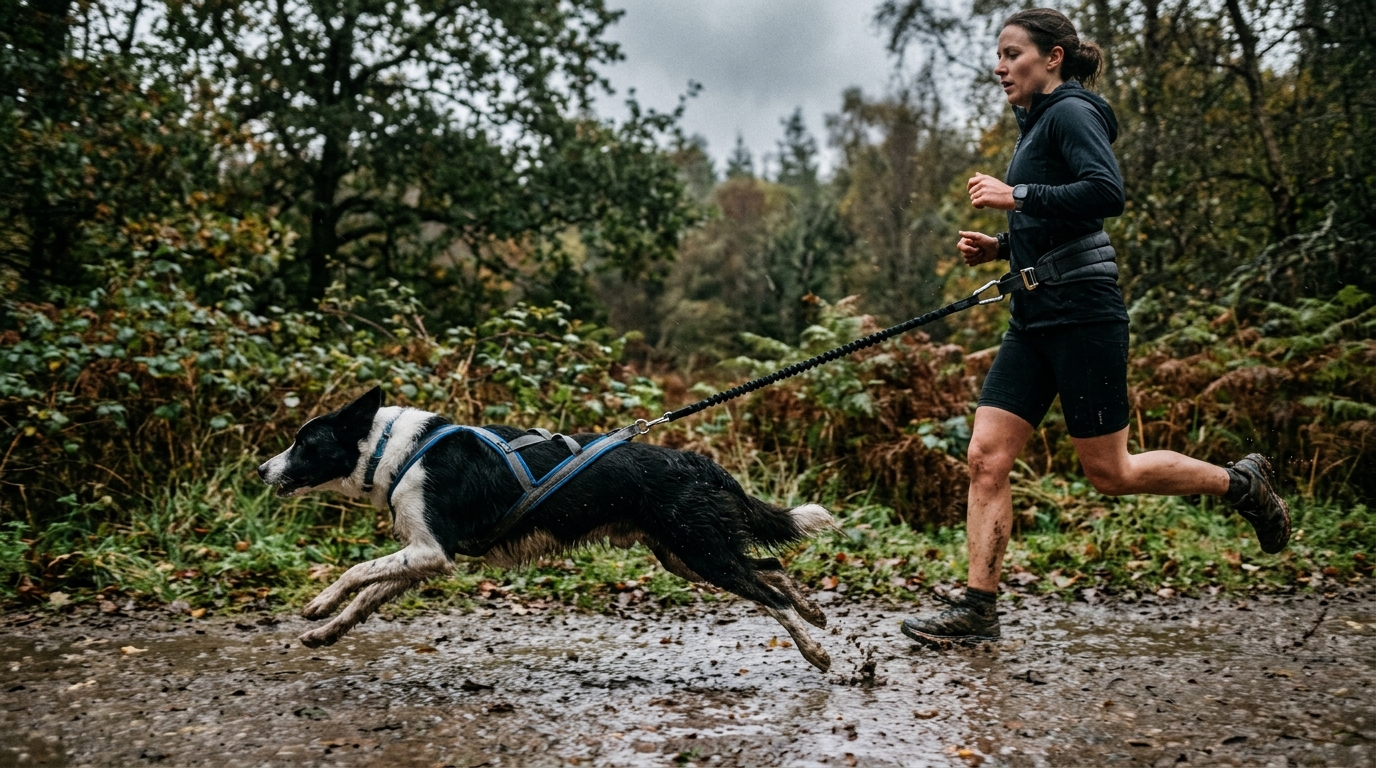
Canicross puts you on foot while your dog pulls you via a waist belt and a bungee line. It’s the cheapest and simplest setup, requiring no wheels and minimal technical skill. Bikejoring swaps your shoes for a bike, with the dog attached to a specialised front antenna that keeps the line clear of the wheel. It’s much faster but requires excellent cycling coordination and a dog that consistently listens to directional commands. Scootering has the dog pulling a kick-scooter, offering a lower centre of gravity than a bike and more stability on muddy or icy UK tracks. Each sport relies on the same core principle—the dog does the pulling while you steer and manage the brakes—but they demand entirely different gear, budgets, and confidence levels.
Internal link: For a closer look at the waist belts required for running, see our Best Canicross Belts.
Canicross: The Runner’s Sport
How it works
A padded waist‑belt hugs the runner, while a front‑mounted pulling harness (often a “Non‑stop Dogwear Freemotion” for serious pullers) connects to a bungee line. The bungee stretches under sudden tugs, protecting both the dog’s neck and the runner’s spine.
Gear that matters
The Freemotion is a strong pulling harness, but it’s a one-purpose piece – not ideal for casual walks. For those on a tighter budget, the Zero DC Short offers a lightweight, adjustable fit that works well for deep‑chested dogs, though it can rub around the armpits if not sized well.
Which dogs thrive
Any breed can canicross, but high‑drive, agile dogs – Border Collies, Jack Russell Terriers, and even medium‑sized Labradors – excel. The sport’s low‑speed nature makes it suitable for urban parks, council‑maintained footpaths, and the occasional countryside trail.
UK scene
Canicross is the most popular dry‑land sport across the UK, and Canicross Trailrunners keeps a map of UK groups and clubs, alongside plenty of local groups on social media. A typical beginner’s cost sits at roughly £90–£150 for a decent belt and harness combo, meaning you don’t need to throw money at it before joining a club.
Bikejoring: The Cycling Sport
How it works
The dog wears a strong pulling harness (the same Freemotion is favoured here) linked to a Bike Antenna that mounts onto the bike’s stem. The antenna keeps the line clear of the wheel, preventing dangerous tangles. A bungee line adds shock absorption, letting the rider focus on steering.
Gear that matters
The bike antenna is the essential piece: a sprung arm that guides the line over your front wheel. A side-lead such as the Trixie Dog Biker Set (saddle-bar leash) (paid link) is a different thing: it keeps a calm dog trotting beside the bike rather than pulling in front. It suits gentle rides with a steady dog, not bikejoring.
See Trixie Dog Biker Set (saddle-bar leash) on Amazon → (paid link)
Which dogs thrive
Strong, endurance‑focused breeds – Siberian Huskies, Alaskan Malamutes, and Border Collies – pull the most effectively. Their higher stamina matches the sport’s speed, making it ideal for longer, mixed‑terrain rides.
Safety first
UK road law (specifically Rule 56 of the Highway Code) mandates dogs be kept on a short lead on or near roads. Bikejoring should therefore stick to dedicated cycle paths or off‑road trails. The Bike Antenna is the most important safety piece; without it, the line can snag the front wheel, leading to an immediate loss of control.
Master bike handling before you let the dog pull.
Scootering: The Skier’s Sport
How it works
A pulling harness (often the Freemotion or the more affordable Neewa Sled Pro Harness) attaches to a scooter or pair of skis via a bungee line. The setup mirrors bikejoring but with a lower centre of gravity, offering more stability on slippery surfaces.
Gear that matters
The Neewa Sled Pro Harness is good value if your dog has a husky-type build – it’s durable and comfortable, though sizing can be tricky. Premium users gravitate to the Freemotion, which provides superior pull and breathability but at a higher price point.
Which dogs thrive
Cold‑weather breeds – Huskies, Malamutes, and Bernese Mountain Dogs – love scootering. Their thick coats and high energy make the slower, controlled pull ideal for winter tracks and muddy fields.
UK scene
Scootering is growing, especially in northern England where snow and frost are common. Clubs list events on NATB Dog Sports, and local “Mushing” groups often host beginner scootering sessions.
Choosing Your Sport: A Practical Breakdown
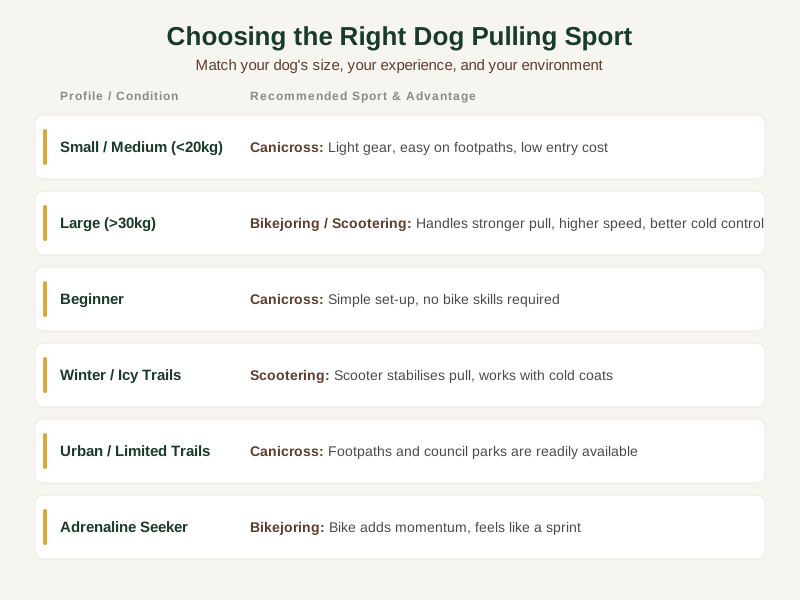
The decision isn’t about the best sport overall, but which one fits your specific situation. This breakdown helps you match your circumstances to the most suitable activity.
| Situation | Best Sport | Why |
|---|---|---|
| Small or medium‑sized dog (up to 20 kg) | Canicross | Light gear, easy on footpaths, low entry cost |
| Large, high‑energy breed (over 30 kg) | Bikejoring or Scootering | Handles stronger pull, higher speed (bikejoring) or better control in cold (scootering) |
| Complete beginner to dry‑land sports | Canicross | Simple set‑up, no bike skills required |
| Frequent winter training on icy trails | Scootering | Scooter stabilises the pull, works well with cold‑weather coats |
| Urban environment with limited trail access | Canicross | Footpaths and council parks are readily available |
| Want the adrenaline rush of speed | Bikejoring | Bike adds momentum, feels like a sprint |
that canicross is the most accessible – you need only a belt, a harness and a suitable path. If your dog is a heavyweight puller or you’re keen on winter training, bikejoring or scootering become the logical next steps.
Getting Started in the UK: What You Actually Need to Do
Finding a club
- Canicross UK maintains a searchable directory of clubs by county.
- Local councils often list sport groups on their community pages; a quick search for “Canicross club + [Your County]” usually surfaces a Facebook group.
- The K9 Trail Time blog also publishes monthly meet‑up calendars for bikejoring and scootering.
Safety & legal basics
UK road regulations require dogs to be on a lead when near any road. For bikejoring and scootering, keep to designated cycle paths or private trails managed by bodies like Forestry England, where road traffic is minimal.
Always wear a high‑visibility jacket and equip your dog’s harness with reflective tape – low light on rural tracks is a real hazard.
Start on flat, soft ground (grass or packed sand) before tackling hills; the bungee line will absorb the initial shock and teach both you and your dog the “whoa” command.
First‑session checklist
- Fit the harness snugly – a loose harness rubs around the armpits.
- Attach the bungee line and test a few short pulls to ensure it doesn’t snag.
- Practice “stop” and “turn” commands on a quiet path.
- Carry a water bottle and a small first‑aid kit – UK weather can turn on a dime.
“You don’t need expensive gear to start – the real value is joining a local club and learning the basics,” a common theme among British participants.
What to Do Next
You now have a clear picture of each sport’s mechanics, the gear that truly matters, and how to find a supportive community near you. If you’re ready to take the next step, grab our Free Canicross Starter Checklist – it walks you through the kit, the first sessions, and the common beginner mistakes worth dodging.
If you’re still weighing up your options, have a browse through our blog for more gear reviews, or get in touch with us if you’re struggling to locate a club in your area.
Key take‑aways
- Canicross is the low‑barrier entry point, perfect for most breeds and urban settings.
- Bikejoring offers speed and excitement but demands bike handling skills and a solid Bike Antenna.
- Scootering shines in winter, giving control for high‑energy, cold‑weather dogs.
- Local clubs are the fastest route to safe, affordable gear and expert guidance – don’t skip that step.
Ready to lace up your shoes, clip in your bike, or hop on a scooter? The adventure awaits, and the right sport is just a decision away.
Dog Sport Comparison
| Dog Size | Best Sport | Why |
|---|---|---|
| Small/Medium (up to 20kg) | Canicross | Light gear, easy on footpaths, low entry cost |
| Large (over 30kg) | Bikejoring or Scootering | Handles stronger pull, higher speed or better cold control |
| Beginner | Canicross | Simple set-up, no bike skills required |
| Winter/Icy Trails | Scootering | Scooter stabilises pull, works with cold coats |
| Urban/Limited Trails | Canicross | Footpaths and council parks are readily available |
| Adrenaline Seeker | Bikejoring | Bike adds momentum, feels like a sprint |
Frequently Asked Questions
Do I need a licence to bikejor or scoot?
No formal licence is required in the UK, but you must obey local road laws. This means keeping your dog on a lead on roads and paths shared with cyclists or horse riders (Highway Code Rule 56) and riding only where cycling is allowed: bridleways, byways and cycle tracks, not public footpaths.
How much does a decent pulling harness cost?
Most proper pulling harnesses cost roughly £40–£90 in the UK, with popular models such as the Non-stop Freemotion at the upper end (around £70–£90). Fit to your dog’s shape matters more than the price.
Can I use the same harness for canicross and bikejoring?
Yes, the same pulling harness works for both sports. You just need to ensure the attachment points sit correctly with the bike antenna when you switch over to bikejoring.
What’s the safest surface for a first run?
Flat grass or a packed dirt trail is the safest surface for a first run. The softer ground cushions the dog’s joints during the pull and allows you to focus on your braking and commands without worrying about wheel slips.
How often should I replace my bungee line?
Replace your bungee line when you notice fraying, reduced elasticity, or worn hardware — don’t wait for a failure mid-run. Owners highly recommend swapping it out early if you notice any fraying or a loss of elasticity, as reliable shock absorption is what protects your back.
Related Guides
For a complete overview, see our What Is Bikejoring? A UK Beginner’s Guide.
Where I Learned This
As an Amazon Associate we earn from qualifying purchases.
Note: General guidance only, verify details with a qualified professional or official source.