What Is Bikejoring? A UK Beginner's Guide
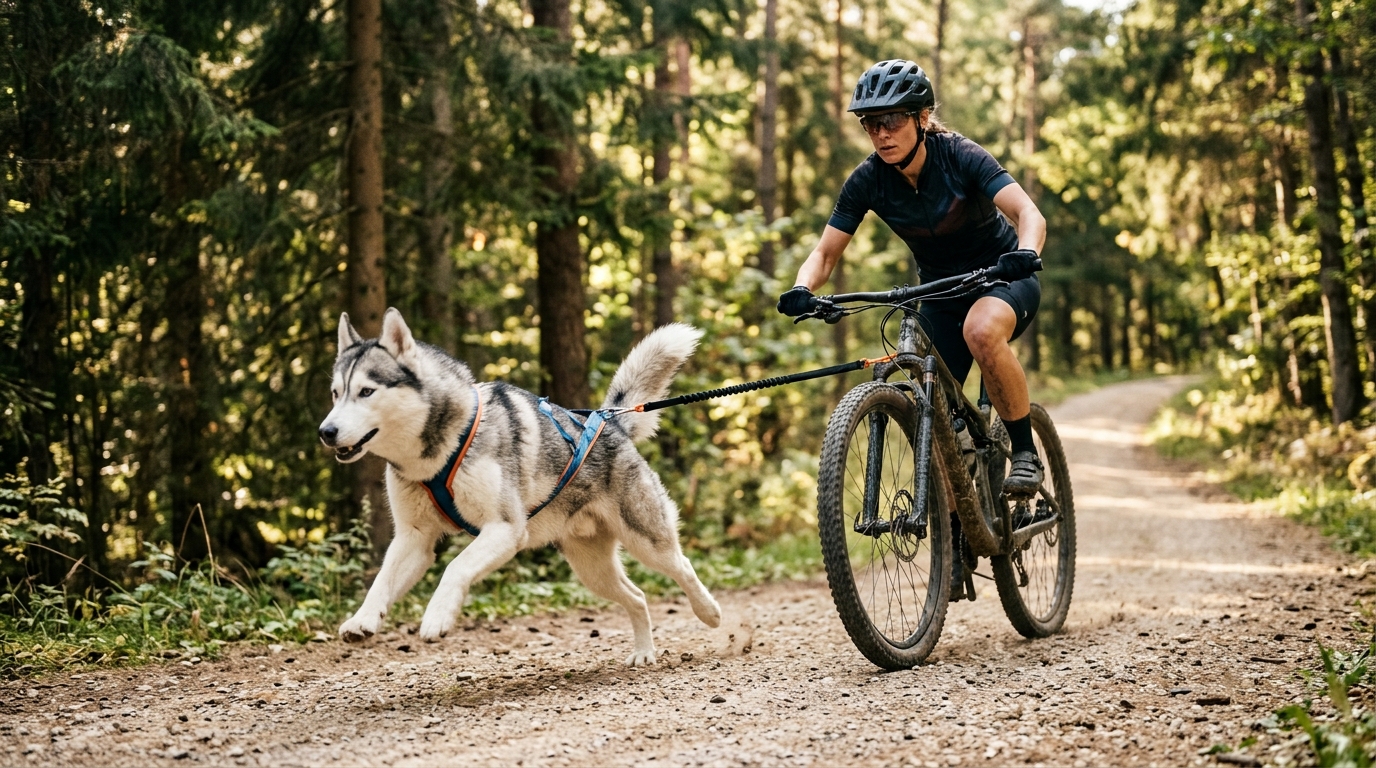
Bikejoring is canicross on wheels. Your dog runs out in front in a pulling harness, a bungee line runs back to your bike, and you pedal, brake and steer while the dog provides much of the power. It’s fast, it’s a brilliant outlet for high-energy dogs, and it goes wrong quickly if the dog doesn’t stop or turn when you ask.
So the most useful advice comes first: if your dog hasn’t done some canicross, start there. The commands, the harness and the habit of running out front all transfer. Learning them at 6 mph on foot is a lot safer than learning them at 15 mph on a bike. If you’re still choosing a sport, our comparison of canicross, bikejoring and scootering sets out the differences.
Is your dog built for bikejoring?
Bikejoring asks more of a dog than canicross does: higher speeds, longer distances and more pulling. The dog needs to be:
- Fully grown. No pulling before at least 12 months, and later for large breeds whose joints are still developing. Ask your vet.
- Fit and sound. Running is no problem, but sustained pulling needs a dog with good hips, elbows and condition.
- Big and keen enough. Medium to large, athletic dogs suit it best, along with plenty of crossbreeds with a working background. Huskies and other sled breeds, pointers, collies and hound crosses are common. Small dogs can run alongside, but they can’t safely pull a bike and rider.
- Biddable at speed. Drive is great, but a dog that lunges at every rabbit is a crash waiting to happen.
Our bikejoring suitability guide covers size, drive versus reactivity, and a simple at-home test.
The gear you need
A pulling harness. The same type you’d use for canicross: it lets the dog pull from the chest and shoulders, with the line attached on the dog’s back. A walking or no-pull harness won’t do. Fit to your dog’s shape matters more than the brand. Our harness guide explains how to choose.
A bungee line, usually longer than for canicross. It needs to keep the dog well clear of your front wheel. Bike lines are commonly around 2.5–3 metres, and the elastic section takes the jolt out of sudden accelerations for both of you.
A bike antenna. This is the bit people miss. The antenna is a sprung arm that clamps to the bike’s head tube or under the stem. The line runs through its tip, which holds it up and forward, away from your front wheel. Without one, slack line drops into the spokes the moment the dog slows, and you go over the bars. Clip the bike end of the line on with a quick-release so you can separate dog and bike in a hurry. Our bikejoring gear setup guide explains mounting and adjusting it.
A suitable bike. A mountain bike or sturdy hybrid with good disc brakes, flat pedals and tyres that grip on mud. You don’t need anything specialist, and a road bike is a bad idea. Our guide to bikes for bikejoring covers what to look for and what to avoid.
Your own safety kit. A helmet, gloves (you’ll put a hand down at some point) and lights for winter afternoons.
How to train for your first ride
Take it in stages, and only move on when the previous one is boringly reliable.
- Commands on foot. “Let’s go” to start, “steady” to slow, “stop” or “whoa”, and “left” and “right” at junctions. “On by” is for ignoring distractions. Many mushers use “gee” for right and “haw” for left. Use whichever words you like, but be consistent. Teach them on walks and canicross first. Our command training guide shows how to get them working at speed.
- Introduce the bike. Walk the bike with the dog in harness out in front, so the dog gets used to the noise and the line being attached to something that moves.
- Short, slow, flat. Ride in a low gear on a wide, quiet, flat track for a few minutes. Let the dog pull while you pedal gently. Brake gradually; never let the line go slack and loop. Stop while the dog is still keen.
- Build up gradually. Add distance, then gentle hills, over several weeks. Keep the speed down on descents: the dog should never have the bike running up behind it.
Watch the dog, not your speedometer. Heavy, ragged panting, a dropping pace or a dog drifting back towards the bike all mean stop, rest and give water.
Heat matters even more than in canicross, because the dog is working harder for longer. Most UK dryland enthusiasts ride from autumn to spring and avoid warm or humid days altogether. Read our hot weather guide before you ride in anything above a cool morning.
Where you can ride in the UK
In England and Wales, cycling is allowed on bridleways, restricted byways and byways, but not on public footpaths unless the landowner allows it. On bridleways, cyclists have to give way to walkers and horse riders. With a dog out in front, that means slowing right down and stopping early, not ringing your bell and squeezing past.
- Forestry tracks are often the best places to ride: wide, well-surfaced and shared by fewer people. Check the local forest’s rules for dogs and bikes, as they vary.
- Open access land gives you a right to walk, not to cycle, and between 1 March and 31 July dogs there must be on a lead of no more than two metres.
- Livestock: the fine for livestock worrying has been unlimited since March 2026, and the offence covers roads and paths. Stop and walk past animals with the dog held close.
- Scotland has wider access rights that include cycling, as long as you ride responsibly.
Our guide to where you can legally run with your dog has more on rights of way and passing other trail users.
Finding other bikejorers
The bikejoring community overlaps heavily with canicross and sled dog sports. Many canicross groups have members who bike or scooter. Canicross Trailrunners keeps a map of UK groups, and dryland mushing clubs run training days and races, mostly through the autumn and winter. Riding with experienced people for your first few outings is the safest way to learn.
Common Questions
Is bikejoring safe for dogs?
It can be, for a fully grown, fit dog in a proper pulling harness, on a bungee line, at sensible distances and in cool weather. The main risks are overheating, injury from starting too young or doing too much too soon, and collisions when commands aren’t reliable.
Do I need a special bike?
No. A mountain bike or sturdy hybrid with good disc brakes and grippy tyres is fine. The essential extra is an antenna to keep the line away from your front wheel.
Can I bikejor with my dog on a normal lead beside the bike?
That’s cycling with a dog alongside, not bikejoring. It’s a common cause of accidents, because the dog can pull you sideways under the bike. If you want the dog working with the bike, it should run out front, in a harness, on a bungee line through an antenna.
What’s the difference between bikejoring and scootering?
The equipment and the braking. A scooter is lower and easier to step off, which some people prefer for a first dryland sport. Our sport comparison covers both.
Your bikejoring reading list
- Is my dog built for bikejoring?
- How to set up bikejoring gear (without the antenna tangle)
- Best bikes for bikejoring, and what to avoid
- Bikejoring vs canicross vs scootering
- Start with canicross: the beginner’s roadmap
References
Note: General guidance only, verify details with a qualified professional or official source.