Best Bikes for Bikejoring (And What to Avoid)
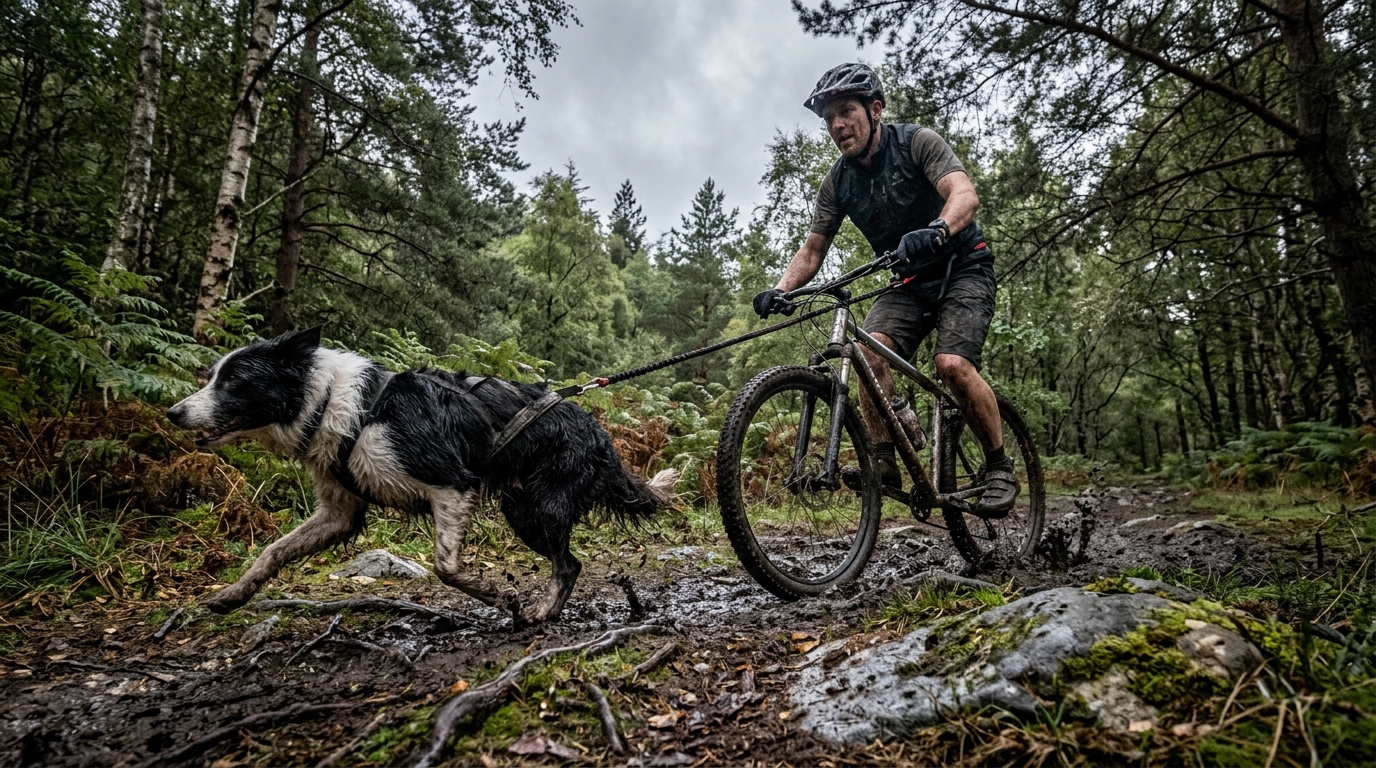
The moment a 30 kg dog pulls at speed, a standard road bike becomes a liability — the front wheel lifts, rim brakes lose their grip on wet tarmac, and the geometry that’s perfect for commuting is exactly wrong for this sport. Here is what actually works for UK bikejoring, what to avoid, and how to stay legal on shared trails.
Why is a standard road bike dangerous for bikejoring?
A standard road bike is dangerous for bikejoring because the steep frame geometry causes the front wheel to lift under a dog’s pull, while rim brakes lack the stopping power needed on wet UK roads.
The extra forward force can turn a gentle wobble into a full-on over-the-handlebars crash. Add a wet British lane, and rim brakes lose their grip entirely—stopping distances can easily double compared to a disc-brake setup.
Punctures are the recurring gripe: rough, root-laden forest paths in the Lake District or the Scottish Highlands destroy narrow, high-pressure road tyres. Swapping to wider gravel tyres is the usual fix.
Warning – rim brakes on wet roads: If you’re still on a standard road bike, the combination of a pulling dog and slick pavement is a recipe for a hard stop that could leave you and your pup on the grass.
The “Gravel vs. Mountain Bike” UK Debate
Gravel bikes – the speed king for mixed surfaces
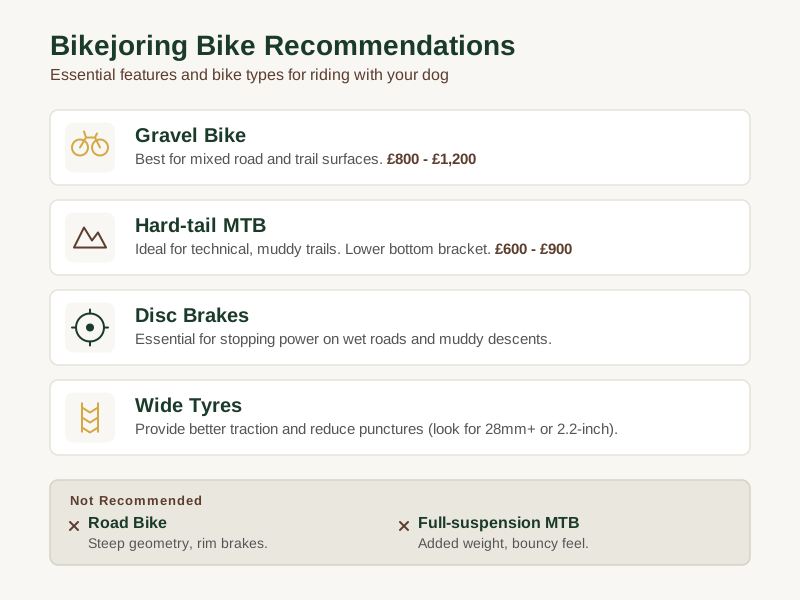
Gravel bikes sit somewhere between a road bike and a cyclocross machine. Their relaxed geometry (a slacker head angle) helps keep the front wheel down when the dog pulls, and the ability to fit 35 mm tyres means you can clear a few centimetres of mud without sacrificing roll-on speed. For the typical weekend rider who spends most of the route on bridleways or quiet lanes, a gravel bike offers the best of both worlds. You’ll still look tidy on the commuter route, but you won’t be stuck in a ditch on a rainy Saturday.
Mountain bikes – the mud king for technical trails
Hard-tail MTBs (front suspension only) dominate the muddy, root-heavy trails of the Peak District, the Forest of Dean, and the Scottish moors. The wider 2.2-inch tyres bite into soft ground, and the lower bottom bracket reduces the chance of the bike pitching forward. Full-suspension rigs are generally overkill for bikejoring. The extra weight and the bouncy feel make it much harder to keep a steady line when the dog is pulling hard.
The verdict
If most of your rides are on paved or compacted paths, a gravel bike is fine—just make sure it has disc brakes and 28 mm+ tyres. If you regularly hit the rough, wet tracks that pepper the UK countryside, a hard-tail mountain bike is the safer, more durable choice.
Critical Features to Look For (And What to Avoid)
- Brakes – disc, preferably hydraulic. Discs stop far shorter than rims, especially on wet leaves or after a sudden dog sprint.
- Frame geometry – relaxed or “bikejoring-friendly”. A slacker head angle (around 71-72°) and a longer wheelbase keep the front end planted when the dog pulls.
- Tyres – 28 mm+ for gravel, 2.0-2.4 in for MTB. Wider tyres give better traction and reduce the chance of pinch flats on rough terrain.
- Drop-bar vs. flat-bar. While many prefer drop-bars for road efficiency, a flat-bar gives a more upright riding position, which takes the strain off your back when the dog is tugging.
What to avoid: Cheap mountain bikes that come with narrow 1.9-inch tyres and low-cost rim brakes. They’re a budget trap that owners constantly flag as a source of punctures and poor control.
Checklist for the buyer
- Disc brakes (hydraulic if you can swing it)
- Relaxed geometry (head angle ≥ 71°)
- Wide tyre clearance (28 mm+ or 2.0-in+)
- Sturdy rear dropout for the tow-line attachment
Recommended Bikes for UK Bikejoring
Best overall (Gravel) – Canyon Grizl (or similar wide-tyre gravel model). Priced roughly £800-£1,200, it ships with hydraulic disc brakes, a relaxed frame, and clearance for 38 mm tyres—perfect for the mixed road-trail combo most UK riders face.
Best overall (MTB) – Trek Marlin (hard-tail) or Specialized Rockhopper. Both sit in the £600-£900 range, have 2.2-inch tyres, and a geometry that keeps the front wheel planted under pull. For heavier riders (over 90 kg) the Marlin’s aluminium frame offers a bit more stiffness, which helps control on muddy descents.
Budget option – A second-hand hard-tail MTB from a local bike shop. You can often find a decent model for £300-£450; just double-check that it has disc brakes and the tyre clearance you need.
If you mix lanes and tracks, a wide-tyre gravel bike such as the Canyon Grizl is the better fit; if you’re mostly on rough, wet trails, a hardtail like the Trek Marlin is. Want to read more about tackling local routes? Check out the Mud and Paws Blog.
What to Avoid (The “Don’t Buy” List)
- Full-suspension MTBs. The added weight and the bouncy feel make it harder to maintain a straight line when the dog is pulling hard. In muddy conditions, the rear suspension can also soak up the pull you actually need to steer.
- Road bikes with rim brakes. As highlighted earlier, the stopping power drops dramatically on wet UK roads, and the geometry encourages the front wheel to lift.
- Cheap hybrids with narrow tyres. They often come with low-end disc brakes that feel spongy, and the tyre width (typically 25 mm) doesn’t clear the mud that British trails love to throw at you.
How to Set Up Your Bike for Bikejoring
Step 1: Fit the bike antenna Attach a flexible bike antenna to your head tube or handlebars. This stops the towline from dropping into the front wheel if the dog suddenly stops, which is the single most common cause of over-the-bars accidents. The Inlandsis Bikejor Max (paid link) is one built for exactly this job.
Find the Inlandsis Bikejor Max on Amazon → (paid link)
Step 2: Secure the towline Loop a bungee towline (usually 2 to 2.5 metres long when stretched) through the antenna and attach it securely to the bike’s frame. The bungee section absorbs the shock of sudden pulls, protecting both your back and the dog’s harness.
Step 3: Drop your tyre pressures For muddy UK trails, drop your tyre pressure slightly lower than you would for road commuting. This gives the tyres a wider footprint, offering better grip when the dog pulls you through wet or slippery sections.
Step 4: Test the brakes Before clipping the dog in, do a hard stop test on the surface you’re about to ride. Make sure your disc brakes are biting properly and haven’t glazed over from a previous wet ride.
UK-Specific Safety & Legalities
- Lights: A white front light and a red rear light are mandatory for any bike used after dark on public roads, according to UK Government road vehicle lighting regulations. Reflectors on the wheels and pedals are also required.
- Bell: The Highway Code demands a working bell on any bike you ride on public roads. It’s a simple way to alert walkers and horse riders on shared paths.
- Helmet: Not a legal requirement for adults, but highly recommended—especially when a dog can add sudden forces.
- Trail etiquette: On bridleways, give way to walkers, horse riders, and other cyclists. Keep the towline short enough that you can react quickly if a dog lunges at a passerby.
Quick legal checklist
- White front light, red rear light, reflectors
- Bell fitted and functional
- Helmet worn (best practice)
- Tow-line attached to a secure rear dropout
Frequently Asked Questions
Do I need a special bike for bikejoring?
No, you don’t need a purpose-built bikejoring bike. But you absolutely need disc brakes and a relaxed geometry. A standard road bike is too risky because of its steep head angle and rim brakes.
Can I use a full-suspension mountain bike?
You can, but it adds unnecessary weight and a bouncy feel that makes steering under pull much harder. Most UK owners recommend a hard-tail for a smoother, more controlled ride on mud-laden trails.
What size bike should I get?
You should be able to stand over the top tube with about 2 to 3 inches of clearance. A professional bike fit is worth the extra £50-£100, especially if you plan to ride with a dog that adds forward force. It ensures the frame size matches your reach and stack for safety. If you’re unsure about getting started, reach out to us via our contact page.
Bikejoring Bike Comparison
| Bike Type | Best For | Key Feature | Typical Price Range |
|---|---|---|---|
| Gravel Bike | Mixed surfaces, road and trail | Relaxed geometry, 28mm+ tyres | £800-£1,200 |
| Hard-tail MTB | Technical, muddy trails | 2.2-inch tyres, lower bottom bracket | £600-£900 |
| Road Bike | Not recommended | Steep geometry, rim brakes | N/A (Avoid) |
| Full-suspension MTB | Not recommended | Added weight, bouncy feel | N/A (Avoid) |
Ready to Start?
You now have the key facts: disc brakes are non-negotiable, a relaxed frame geometry keeps you upright, and wider tyres are exactly what you need for the UK’s muddy trails. If you’re leaning towards a gravel bike, the Canyon Grizl ticks all the boxes without breaking the bank. If you’re more trail-focused, a hard-tail MTB like the Trek Marlin gives you the grip and control you need.
Ready to make a confident decision? Get the Free Canicross Starter Checklist – it walks you through the final safety checks and helps you compare prices so you don’t over-pay.
Remember, the right bike makes bikejoring a joy rather than a faff. Pick a bike that matches the terrain you’ll tackle, fit the tow-line securely, and you’ll be set for countless miles of wind-in-your-hair, mud-splattered fun with your four-legged partner. Happy riding!
Related Guides
For a complete overview, see our What Is Bikejoring? A UK Beginner’s Guide.
Further Reading
Note: General guidance only, verify details with a qualified professional or official source.